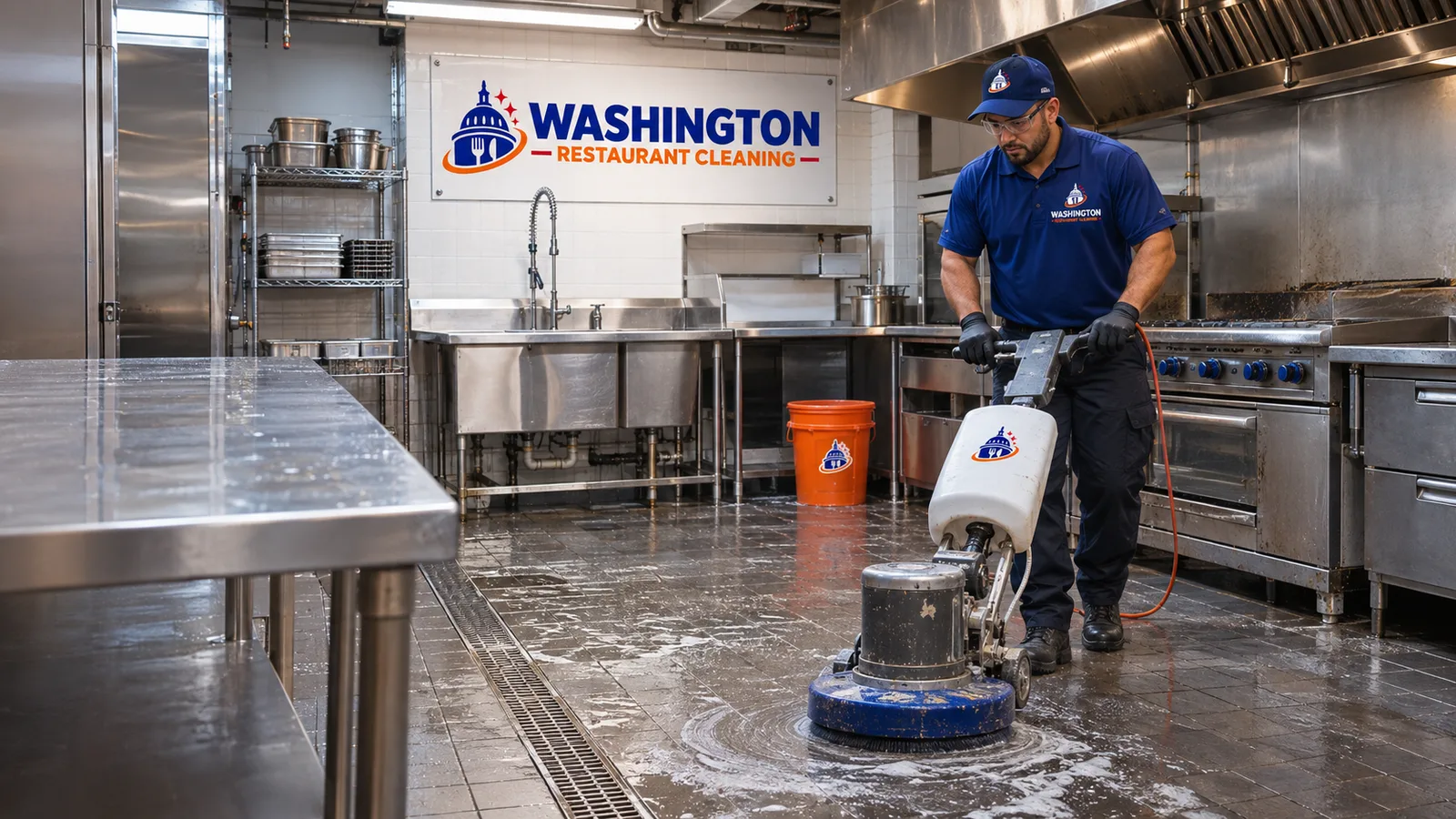
A technician using a commercial floor-cleaning machine on tile in an empty restaurant kitchen, with equipment, drains, and work areas visible.

Kitchen Floor Cleaning · Washington, DC

Commercial Kitchen Floor Cleaning

Remove bonded grease, food residue, and soil from restaurant tile and grout with a cleaning plan built around your kitchen's surfaces, equipment, and operating schedule.

✓Tile and grout ✓Grease removal ✓Soil recovery ✓Operating-hour planning

Defined floor scope

A Cleaner, Safer Working Surface for Your Kitchen

Commercial Kitchen Floor Cleaning targets the greasy film and impacted soil that routine mopping often leaves behind. Cooking oil, tracked-in grit, food particles, and detergent residue can collect in grout joints, corners, textured tile, and the floor around fixed equipment. As buildup accumulates, the surface may remain slippery or look dull even after an ordinary closing clean.

Washington Restaurant Cleaning provides restaurant floor cleaning services for commercial kitchens in Washington, DC. Working as a professional restaurant company in Washington, DC, we plan the work around the floor material, soil load, drainage, equipment placement, and hours when the kitchen can be taken out of service. Our address on 24th Place NE gives our team a practical base for serving food operations across the District.

The goal is a properly cleaned floor without disrupting food preparation. Before work starts, we identify sensitive areas, check access to the floor, and establish which equipment can be moved safely. We also discuss drying time and the point at which staff can return to the area.
Request a Callback

Floor materials

Restaurant Tile Cleaning and Grout Cleaning

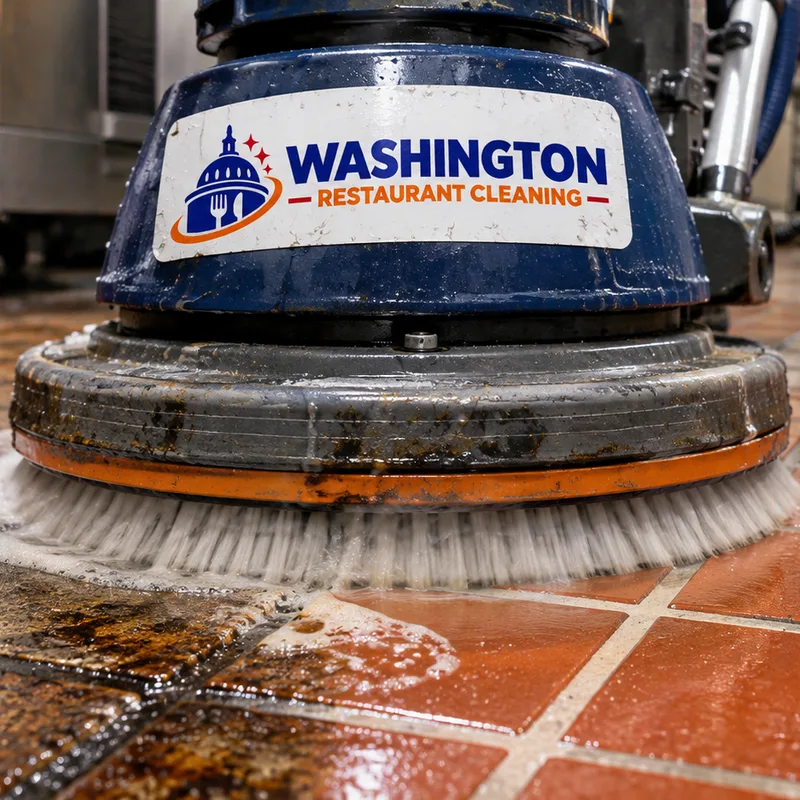
A close view of commercial kitchen quarry tile and grout being mechanically scrubbed, showing a clear contrast between cleaned joints and greasy buildup.

Restaurant tile is built for hard use, but its texture and joints can trap contaminants. Quarry tile is common in commercial kitchens because it is durable and slip resistant. Ceramic and porcelain surfaces may also be present in prep areas, service corridors, dishwashing spaces, and restrooms. Each surface needs compatible chemistry and controlled agitation.

Restaurant tile cleaning begins with dry soil removal and a surface assessment. The cleaning agent must be suitable for the tile, grout, nearby metals, and any coating or sealer. After dwell time softens the residue, mechanical agitation helps release soil from textured surfaces. The floor is then rinsed or extracted so suspended grease is removed rather than spread into another area.

Restaurant grout cleaning requires focused attention because recessed and porous joints collect dark residue. Brushes or suitable floor equipment agitate the joints, while edge work addresses wall lines, corners, thresholds, and equipment legs. Damaged grout, loose tile, failing sealant, and drainage problems are maintenance issues rather than cleaning defects; we identify visible concerns so the operator can arrange the appropriate repair.

Cleaning scope

What Restaurant Floor Cleaning Covers

Request a Callback
✓

Kitchen Floor Degreasing

A commercial degreaser is selected for the soil and surface, given appropriate dwell time, and agitated to loosen bonded cooking oils and greasy residue.

✓

Tile and Grout Agitation

Mechanical scrubbing and detail brushing work soil out of textured tile, recessed grout joints, corners, edges, and other areas a mop does not clean thoroughly.

✓

Rinse and Soil Recovery

Dirty solution is recovered using methods suited to the room and its drainage. This step limits redeposition and removes detergent residue that can leave a tacky film.

✓

Equipment Perimeters

Accessible flooring around cook lines, fryers, preparation tables, shelving, and dishwashing equipment receives focused cleaning. Equipment movement is agreed upon before service.

✓

Entry and Transition Areas

Doorways, thresholds, service corridors, and transitions between kitchen and dining spaces are cleaned according to their material and condition.

✓

Scheduled Maintenance

Recurring commercial floor cleaning can be arranged around operating hours, with the scope adjusted for traffic, cooking volume, floor condition, and problem areas.

Floor-cleaning workflow

Our Commercial Kitchen Floor Cleaning Process

  1. Step 1 of 5

    Assess the Floor and Work Area

    We identify the tile or flooring type, grout condition, grease concentration, drainage, floor transitions, and obstacles. A small compatibility test may be appropriate when the material, coating, or prior treatment is uncertain.

  2. Step 2 of 5

    Prepare the Kitchen

    Loose debris is removed, accessible items are cleared, and sensitive surfaces are protected as needed. The agreed scope defines who moves mobile equipment and which fixed units remain in place.

  3. Step 3 of 5

    Apply the Cleaning Solution

    A compatible product is applied at the proper dilution. The solution receives enough dwell time to break up oily soil without being allowed to dry on the floor.

  4. Step 4 of 5

    Agitate Tile, Grout, and Edges

    Commercial equipment loosens buildup across the main floor. Hand tools address grout lines, corners, wall edges, drains, and tight spaces where a larger machine cannot reach.

  5. Step 5 of 5

    Rinse, Recover, and Review

    Released soil and cleaning solution are removed, and additional passes are made where needed. We review the floor and discuss drying, access, and any visible maintenance concerns before the kitchen returns to normal use.

Request a Callback

Controlled degreasing

Restaurant Floor Degreasing Without Guesswork

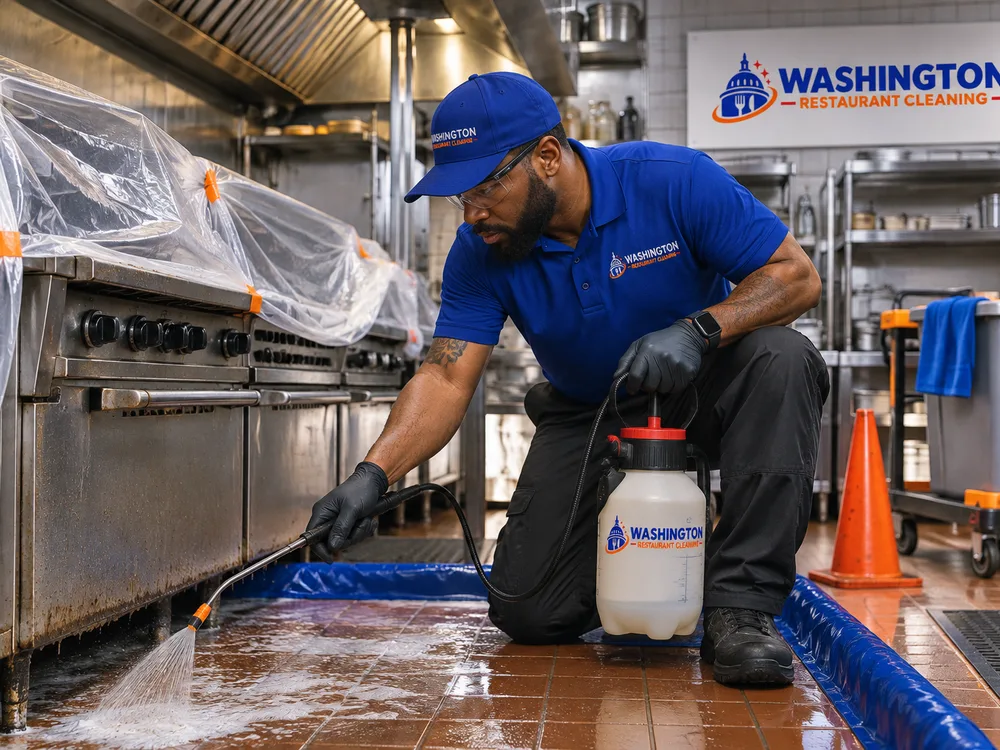
A restaurant floor-cleaning technician applying controlled degreasing solution near a cook line while protecting stainless-steel equipment and keeping the work area contained.

Degreasing is more than applying a strong chemical. The cleaner must match the contaminant and the surface, and its concentration must follow the product label. Too little dwell time may leave bonded oil behind. Excess product or incomplete rinsing can leave residue that attracts soil and may affect traction.

We account for grease migration around fryer stations, cooking lines, dishwashing zones, waste routes, and back doors. These areas can have different soil loads even within one kitchen. Hot water may support cleaning where the surface, product directions, and facility conditions allow, but agitation and soil recovery remain essential.

Floor drains are part of the work plan, not disposal points for unrestricted chemicals or solids. Washington food businesses are subject to District requirements, and operators may also have building or waste-handling procedures that affect how the work is performed. We discuss water access, drains, grease interceptors, and recovery needs before beginning. Safety Data Sheets should remain available for the products used in the facility.

District scheduling

Restaurant Floor Cleaning in Washington, DC

Kitchen access varies sharply across the District. Downtown and Penn Quarter restaurants may need tightly timed work because shared loading areas, dense pedestrian activity, and building access rules limit when equipment can move through the property. Georgetown businesses often operate in older buildings where narrow service routes, steps, and limited staging space should be reviewed before equipment arrives.

Along the H Street NE corridor, late operating hours can make overnight or early-morning cleaning the practical choice. Restaurants around Union Market may combine production, prep, retail, and customer-facing areas, so the cleaning sequence must keep wet work separated from active spaces. In Capitol Hill, compact kitchens and mixed-use buildings can require quieter equipment and careful coordination with property management.

Washington's humid summers and wet winter weather also increase the amount of moisture and tracked-in grit entering service doors. That soil combines with grease and can settle into textured tile. A practical restaurant floor cleaning Washington schedule accounts for cooking volume, foot traffic, weather exposure, and the time available for safe drying. The calendar should be based on the floor's actual condition rather than a generic interval.

Request a Callback

Budget planning

How Much Does Commercial Kitchen Floor Cleaning Cost in Washington?

Commercial kitchen floor cleaning in Washington typically costs about $0.30 to $0.80 per square foot, while small or heavily soiled kitchens may carry minimum service charges of roughly $250 to $600. Detailed grout work, severe grease buildup, difficult access, and after-hours scheduling can raise the total.

Final pricing depends on floor area, material, condition, equipment movement, drainage, parking or loading access, and whether multiple cleaning passes are needed. Recurring service may be priced differently from a one-time restoration clean. The exact cost is confirmed after the kitchen and requested scope are assessed.

Request a Callback

Describe your floor material, kitchen size, grease conditions, and preferred service window so we can prepare a clear scope for the work.

Call for a Free Quote

Scope and scheduling

Commercial Kitchen Floor Cleaning Questions

How long does restaurant floor cleaning take?

A small commercial kitchen may take a few hours, while a larger or heavily soiled facility can require a longer service window. Floor area, grease buildup, grout condition, equipment access, and recovery methods all affect timing. Washington properties with controlled loading docks, elevators, or restricted overnight access may also need added setup time. We establish the work window and expected drying period before service.

Can the kitchen stay open during floor cleaning?

The active cleaning area should be out of food production and kept clear until the floor is clean and sufficiently dry. Wet floors, cleaning agents, hoses, and powered equipment are incompatible with normal kitchen traffic. Some facilities can divide the work into contained zones, but that depends on the layout, ventilation, drainage, and ability to prevent cross-traffic. Scheduling after closing is often the cleaner approach.

How often should restaurant floor degreasing be scheduled?

The right interval depends on cooking volume, fryer use, traffic, floor texture, and the effectiveness of daily cleaning. A high-output cook line may need deeper attention more often than a low-volume preparation area. We recommend an interval after inspecting the buildup pattern, then adjust it if grease begins accumulating between visits. Daily sweeping and mopping remain necessary between professional cleanings.

Will professional cleaning repair dark or damaged grout?

Cleaning can remove soil from sound grout, but it cannot repair missing joints, cracks, permanent discoloration, or deterioration caused by moisture and chemicals. After restaurant grout cleaning, underlying wear may become easier to see. Loose tile and failed joints should be repaired because they can collect water and food debris. We identify visible problem areas, but structural repairs require a qualified flooring professional.

Do you move fryers and other kitchen equipment?

Mobile equipment may be moved when it can be handled safely and the plan is agreed upon in advance. Gas-connected, hard-wired, plumbed, or fixed equipment should only be disconnected or moved by authorized personnel. Many Washington kitchens have compact cook lines, so equipment clearance affects both scope and price. We confirm responsibilities before arrival and clean all safely accessible floor areas.

Is restaurant tile cleaning suitable for quarry tile?

Yes, quarry tile can usually be cleaned with compatible commercial chemistry, agitation, and thorough recovery. The method must account for the tile's texture, grout condition, existing sealers, and nearby materials. A test area may be used if a prior coating or treatment is uncertain. Natural stone, specialty tile, and resinous flooring require separate identification because products appropriate for quarry tile may not suit those surfaces.

What should we do before the cleaning appointment?

Remove food, portable utensils, floor mats, cardboard, and loose items from the scheduled area, then arrange access to water, power, and approved drainage or recovery points. Staff should secure chemicals and identify sensitive equipment. If the property has loading, elevator, parking, or access rules, provide them before service. We will confirm equipment-moving responsibilities and the expected shutdown window as part of the scope.

Plan the scope

Plan a Cleaner Commercial Kitchen Floor

Tell Washington Restaurant Cleaning about the flooring, grease buildup, access limits, and operating schedule. We will help define the right cleaning method, service window, and written scope.