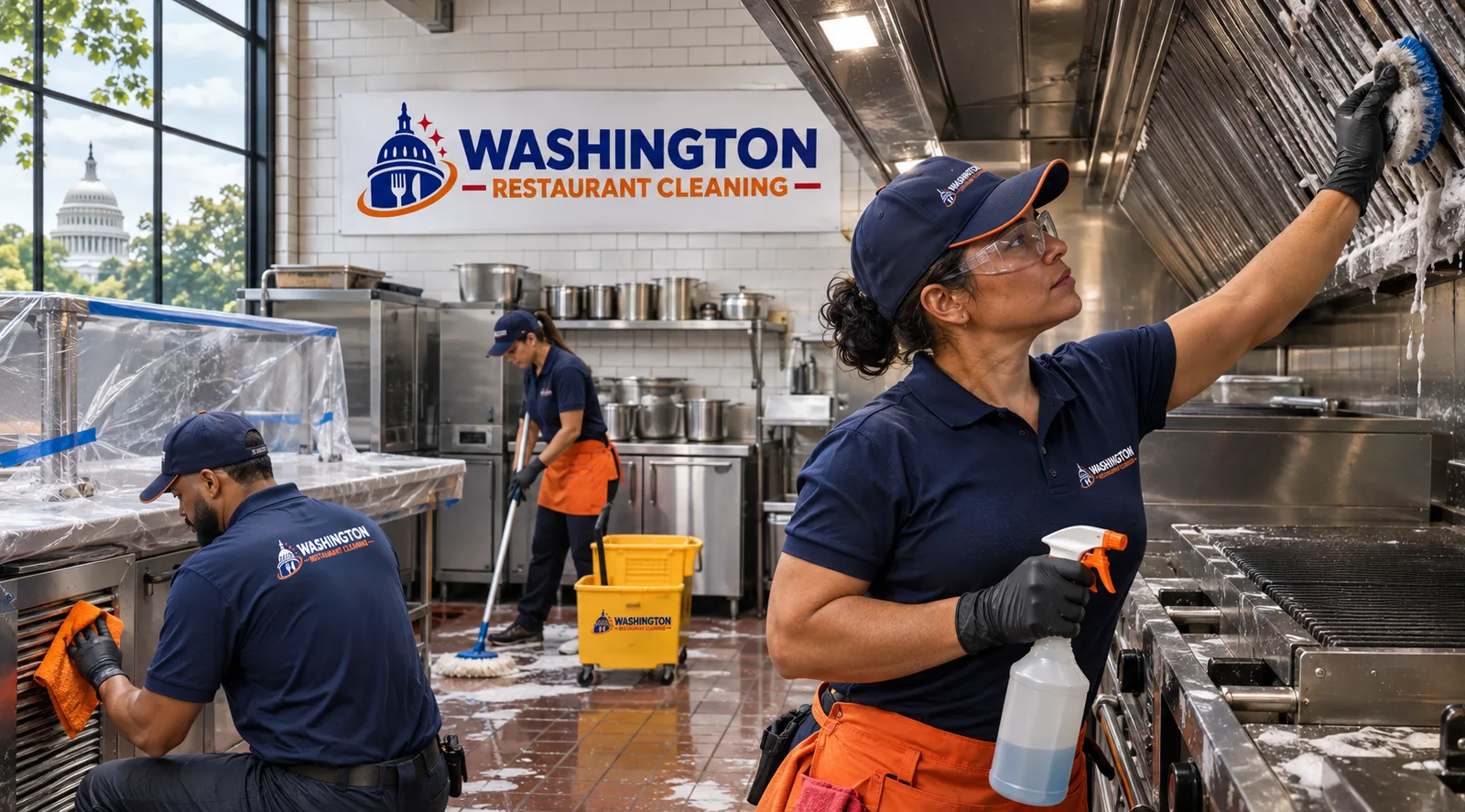
A trained cleaning crew performing a detailed deep clean in a Washington restaurant kitchen, with stainless steel equipment, tiled walls, and protected food-contact surfaces visible.

Restaurant Cleaning · Washington, DC

Restaurant Cleaning Company

Detailed cleaning for commercial kitchens, walk-in coolers, dining areas, storage spaces, and hard-to-reach surfaces, scheduled around your operating hours.

✓Kitchen deep cleaning ✓Walk-in coolers ✓High dusting ✓After-hours scheduling

Defined restaurant scope

Professional Restaurant Deep Cleaning in Washington

A restaurant deep clean should address the grease, food residue, dust, and buildup that routine closing work cannot fully reach. Washington Restaurant Cleaning develops a written scope around the condition and layout of your facility, including the kitchen line, prep and storage areas, walk-in units, dining room, restrooms, and overhead surfaces when requested.

Our crew works as an experienced restaurant team in Washington, with attention to the practical demands of active food-service facilities. Before work begins, we identify sensitive equipment, food-contact surfaces, floor drains, access limits, and any areas that must remain available. We can then plan the work around a closure, scheduled maintenance window, renovation turnover, inspection preparation, or periodic deep-cleaning program.

Washington restaurants vary widely in layout. Compact kitchens near Dupont Circle may have narrow aisles and limited staging space, while restaurants around Union Market often combine production, storage, and customer-facing areas in one operation. Georgetown properties may have constrained loading access or multiple levels. Along the Wharf, high-volume dining can create demanding cleaning windows between service periods. These conditions affect crew size, equipment placement, sequencing, and the time required to complete a detailed clean.

Request a Callback

Facility-wide scope

Restaurant Deep Cleaning Services

✓

Kitchen Deep Cleaning

Degreasing and detailed cleaning can cover equipment exteriors, accessible sides and undersides, stainless steel surfaces, backsplashes, walls, shelving, prep tables, floors, base edges, and floor drains. Food-contact surfaces receive appropriate product selection and final treatment based on the agreed scope.

✓

Walk-In Cooler Cleaning

Walk in cooler cleaning may include empty shelving, walls, doors, gaskets, accessible fan guards, floors, corners, and thresholds. The plan accounts for food removal or protection, temperature control, drying time, and safe product use around stored goods.

✓

High Dusting

High dusting addresses exposed pipes, beams, ducts, ledges, light housings, ceiling vents, and other elevated surfaces that collect dust or greasy residue. Access height, customer areas, and nearby equipment determine whether ladders, extension tools, or other access methods are appropriate.

✓

Dining and Service Areas

Restaurant detailed cleaning can cover chairs, table bases, booths, partitions, host stations, service counters, baseboards, reachable fixtures, and edges missed during routine floor care. We coordinate the work to protect finished wood, upholstery, and decorative surfaces.

✓

Storage and Support Spaces

Dry storage, beverage stations, employee areas, corridors, and waste-handling zones can be included in the scope. Shelving contents and movable items must be addressed before cleaning so crews can reach corners, walls, and floor perimeters.

✓

Restroom Deep Cleaning

Detailed restroom work may include fixtures, partitions, walls, doors, grout lines, vents, dispensers, base edges, and floors. Product choice depends on the surface and the type of buildup present.

Request a Callback

Controlled cleaning methods

Commercial Kitchen Deep Cleaning Washington Restaurants Can Schedule Around Service

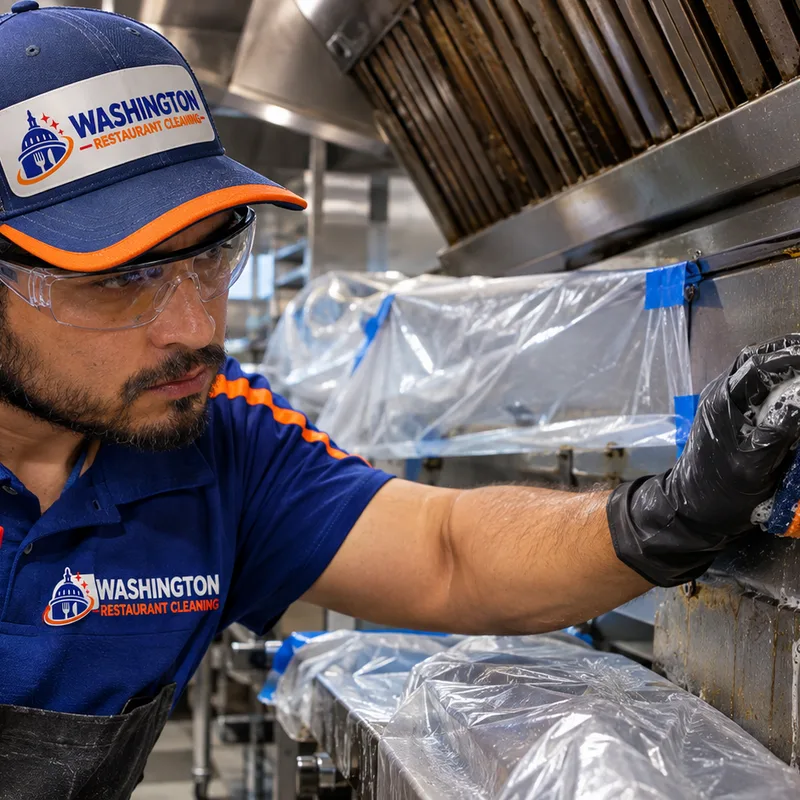
Close view of a restaurant cleaner degreasing the accessible exterior and surrounding surfaces of a commercial cooking line while nearby food-contact areas are protected.
A zone-by-zone approach keeps the scope controlled and protects sensitive surfaces.

Commercial kitchen deep cleaning begins with inspection, not indiscriminate spraying. Different residues require different methods. Grease may need dwell time with an appropriate degreaser, mineral deposits may call for a surface-compatible cleaner, and carbonized buildup often requires repeated treatment and controlled agitation. Product labels, Safety Data Sheets, ventilation requirements, and surface compatibility guide the work.

The kitchen is divided into manageable work zones so loosened soil is not transferred back onto cleaned areas. Crews typically work from higher surfaces toward lower ones, then complete floors after equipment exteriors, walls, and shelving. Color-coded cloths and tools can help reduce cross-contamination between kitchens, restrooms, and customer areas. Clean tools must also be separated from used materials during the job.

Food-contact surfaces require special care. Cleaning removes soil, while sanitizing is a separate step performed with an approved product at its labeled concentration and contact time. Deep cleaning does not replace the restaurant's daily food-safety procedures, pest-control program, hood-system service, or maintenance of refrigeration and cooking equipment.

Cleaning workflow

How Our Restaurant Deep Cleaners Plan the Work

  1. Step 1 of 5

    Inspect the Facility

    We review the layout, soil level, equipment placement, access points, water availability, and areas that require special handling. The restaurant identifies operational limits, sensitive finishes, alarm considerations, and equipment that cannot be moved or disconnected.

  2. Step 2 of 5

    Define the Written Scope

    The proposal identifies included rooms and surfaces, exclusions, preparation responsibilities, expected access, and the planned cleaning window. This gives managers a practical basis for comparing restaurant cleaning companies.

  3. Step 3 of 5

    Prepare and Protect

    Food, utensils, paper goods, and portable equipment are removed, sealed, or protected as agreed. Crews establish work zones, place warning signs where needed, and protect surfaces that are outside the cleaning scope.

  4. Step 4 of 5

    Clean in Sequence

    The crew follows a planned order based on access and soil type. High dusting generally occurs before lower-level detail work, while floors are completed after surrounding surfaces so settled debris can be removed.

  5. Step 5 of 5

    Review the Completed Scope

    A final walkthrough checks the contracted areas and identifies anything requiring follow-up. The restaurant can then complete any operational reopening steps, including replacing stored goods, verifying equipment settings, and restoring its normal food-safety controls.

Request a Callback

Cooler preparation

Walk In Cooler Cleaning Requires Careful Preparation

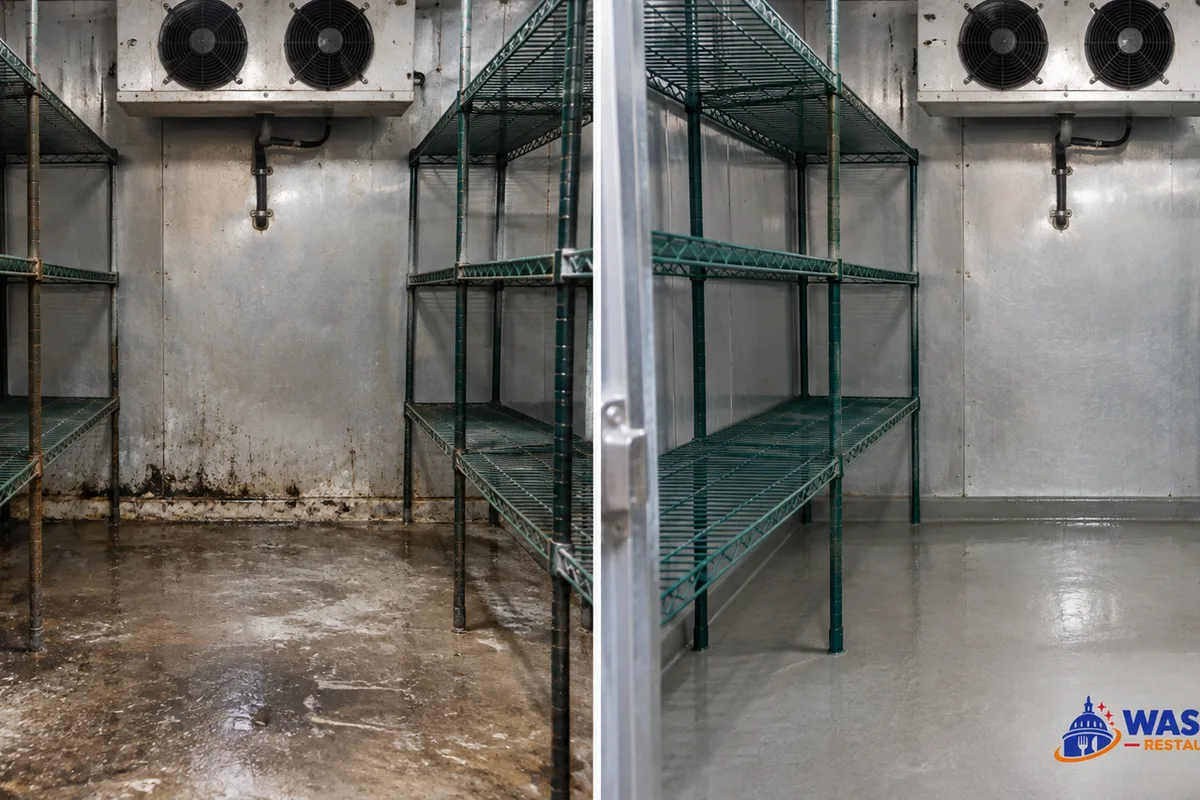
A realistic side-by-side view of empty walk-in cooler shelving and floor edges before detailed cleaning and after residue has been removed, with no food products present.
Empty shelving and controlled product storage allow access to cooler walls, corners, and floor edges.

A walk-in cooler should not be treated like an ordinary room. Food protection, temperature management, electrical components, drainage, and drying all affect the plan. Before cleaning, the operator should determine where products will be held and how safe temperatures will be maintained. The unit should never be shut down or altered unless the restaurant's authorized representative has approved the procedure.

Once access is clear, detailed work may address shelving, wall and ceiling panels, door tracks, handles, gaskets, thresholds, floors, corners, and accessible fan guards. Cleaners avoid saturating electrical parts, controls, lights, and evaporator components. If damaged panels, failing seals, active leaks, heavy ice, or mechanical problems are found, those conditions need qualified refrigeration service rather than cleaning.

Washington's humid summers can make condensation and drying more difficult, particularly when cooler doors remain open during service. Scheduling the work during a controlled closure reduces door traffic and gives cleaned surfaces time to dry before products return.

Proposal review

Choosing a Restaurant Cleaning Company

Request a Callback

Ask each company to describe exactly what its proposal includes. Terms such as “deep clean” and “detail clean” do not define a standard scope by themselves. A useful proposal names the rooms, surfaces, equipment exteriors, access requirements, preparation duties, and exclusions. It should also state whether high dusting, cooler interiors, floor drains, wall washing, or movable shelving are included.

Discuss chemicals and methods before authorizing work. The cleaner should be able to explain why a product suits stainless steel, tile, sealed flooring, painted walls, or another finish. They should also understand the difference between cleaning and sanitizing. If work involves a hood, duct, fan, suppression component, gas connection, electrical assembly, or refrigeration repair, confirm whether a qualified specialist is required. General restaurant deep cleaners should not present technical maintenance as ordinary surface cleaning.

Access planning matters in DC. Loading arrangements, parking restrictions, elevators, security procedures, shared alleys, and limited storage can affect setup. A restaurant near Capitol Hill may have tighter delivery and access controls than a freestanding facility with its own service entrance. Share these conditions during the initial review so labor and equipment are planned accurately.
Budget planning

How Much Does Restaurant Deep Cleaning Cost in Washington?

Restaurant deep cleaning in Washington typically costs about $1,000 to $5,000 for a defined one-time project, while small, limited scopes may cost less and large or heavily soiled kitchens may exceed that range. Pricing depends on square footage, grease and carbon buildup, included equipment, cooler contents, high-access work, overnight scheduling, parking, and whether shelving or appliances must be moved. Recurring detailed cleaning may be priced differently from a one-time restoration clean. The exact cost is confirmed after a facility walkthrough and written scope.

Request a Callback

Get a written scope that matches your kitchen, operating schedule, access conditions, and priority areas before the cleaning date is set.

Call for a Free Quote

Scope and scheduling

Restaurant Deep Cleaning Washington FAQs

How long does professional restaurant deep cleaning take?

A defined deep-cleaning project may take one shift or several shifts, depending on the facility and scope. Kitchen size, grease buildup, cooler preparation, high dusting, equipment access, and drying time all affect the schedule. Tight loading access and limited staging space in parts of Washington can also add setup time. A walkthrough is the best way to establish a realistic work window.

Can cleaning be scheduled after closing?

Yes, restaurant deep cleaning can often be planned overnight, on a closed day, or between operating periods. The restaurant must provide authorized access and identify alarm, security, loading, and building rules in advance. Enough time should remain after cleaning for drying, inspection, product replacement, equipment checks, and the restaurant's reopening procedures.

Do we need to remove food before walk in cooler cleaning?

Food normally must be removed, relocated, or securely protected before interior cooler cleaning begins. The restaurant remains responsible for safe product temperatures and approved temporary storage. The plan should identify who empties shelves, whether the cooler will remain running, which components must stay dry, and when products can safely return.

Does kitchen deep cleaning include hood and exhaust duct cleaning?

Hood surfaces may be included if they are specifically listed, but exhaust ducts, fans, filters, and fire-suppression components require a clearly defined specialist scope. Commercial kitchen exhaust systems involve fire and mechanical considerations beyond ordinary surface cleaning. Confirm the boundaries in writing and coordinate any specialist work with the restaurant's existing inspection and maintenance schedule.

How often should a restaurant schedule detailed cleaning?

The right interval depends on cooking volume, menu, equipment arrangement, hours, and the restaurant's daily cleaning program. Frying and heavy grease production can require more frequent detail work than light preparation. A practical plan assigns daily cleaning to staff and schedules periodic work for overhead surfaces, behind accessible equipment, walk-ins, storage areas, and other locations that cannot be fully addressed during closing.

Can high dusting be completed while the restaurant is open?

High dusting is generally better scheduled when food preparation and customer service have stopped. Dust and debris can fall while pipes, beams, vents, and ledges are being cleaned, so food, utensils, and equipment must be removed or protected. The area also needs safe access for ladders or extension tools, followed by cleaning of lower surfaces.

What should a restaurant do before the crew arrives?

Complete the preparation duties listed in the written scope before the scheduled start. Typical duties include removing exposed food and utensils, emptying agreed shelving, identifying sensitive equipment, securing valuables, arranging loading access, and providing an authorized contact. Managers should also communicate building rules, alarms, water access, waste procedures, and surfaces that require special care.

Plan the scope

Plan a Thorough Restaurant Deep Clean

Tell Washington Restaurant Cleaning which areas need attention, when the facility is available, and what access conditions apply. We will use those details to develop a clear scope for your restaurant.