
Step 1 of 5
Confirm the scope and access
We review the included rooms, floor materials, visible soil, equipment restrictions, water access, drainage considerations, security procedures, and the time available after closing or before opening.
Serving Washington, District of Columbia & surrounding areas
Open 24/7
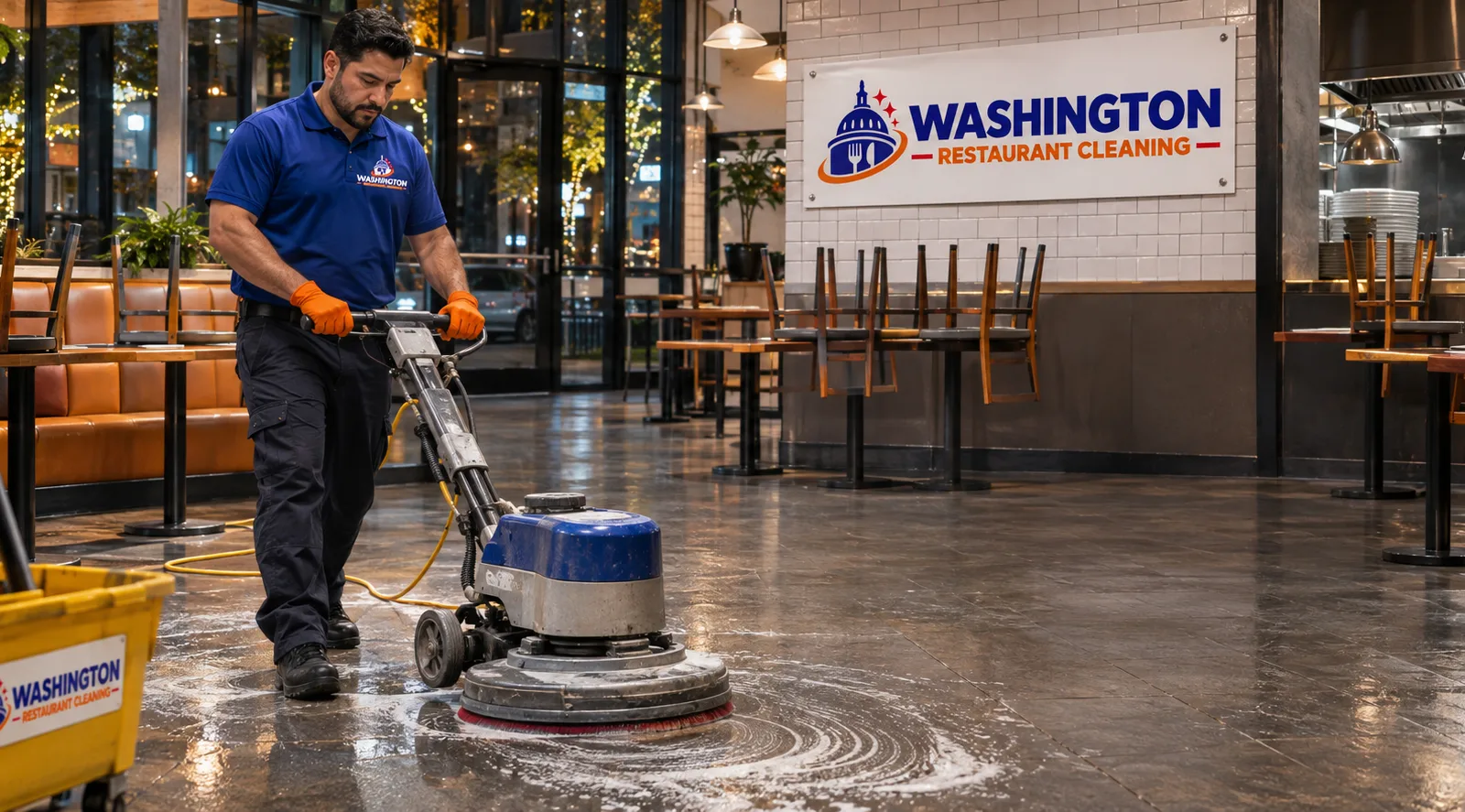
Floor Cleaning · Bethesda
Detailed floor and kitchen cleaning planned around your operating hours, surface materials, equipment layout, and food-service workflow.
Restaurant floor care
Restaurant Floor Cleaning Bethesda calls for more than a quick mop after service. Grease can travel from the cook line into prep areas and dining rooms, while food residue collects along baseboards, beneath movable equipment, and around floor drains. Washington Restaurant Cleaning develops a practical scope based on the flooring, soil level, traffic pattern, and hours available for the work.
We are Washington's restaurant specialists, cleaning around the realities of food service: narrow cook lines, fixed equipment, late closing times, and floors that need to be ready before the next shift. Each plan can address front-of-house floors, kitchen floors, service corridors, storage areas, and other included hard-surface zones without disrupting active meal periods.
Bethesda restaurants near Bethesda Row often contend with steady pedestrian traffic that carries grit onto dining-room floors. Businesses around Woodmont Triangle may have compact layouts where access must be carefully staged. Near the Wisconsin Avenue corridor, frequent deliveries and customer turnover can add tracked soil at entrances and service routes. In each setting, the cleaning method should match the surface and the way the restaurant actually operates.
Kitchen floor detailing
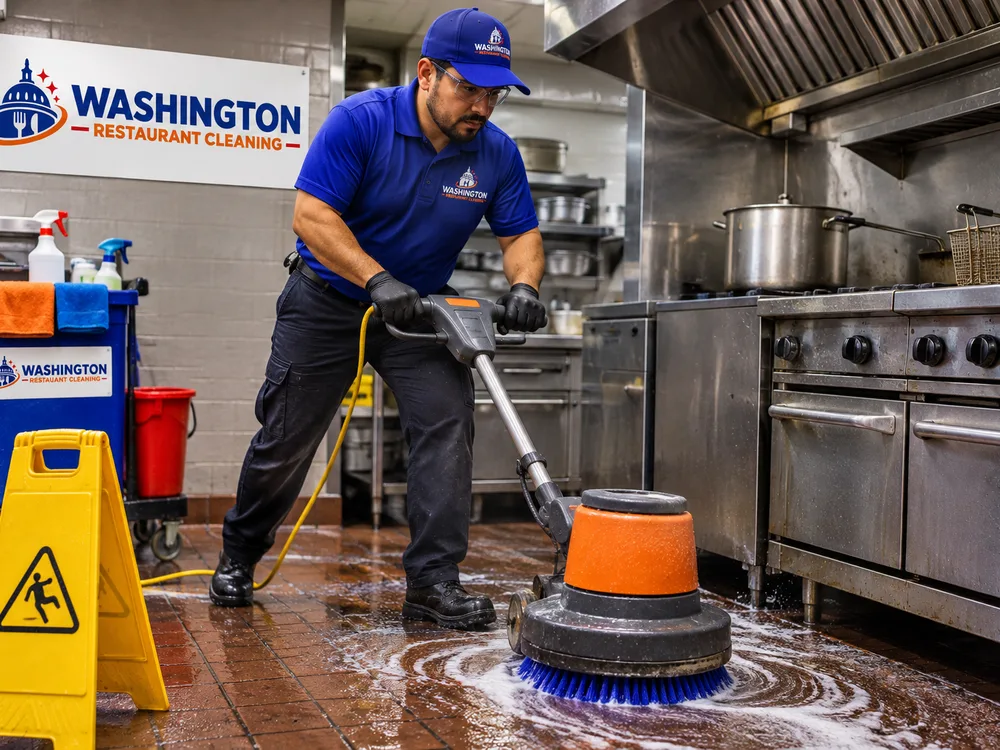
Restaurant Kitchen Deep Cleaning Bethesda targets the residue that routine shift cleaning can leave behind. The exact scope may include degreasing accessible floor areas, detailed edge cleaning, attention around floor drains, cleaning beneath movable equipment, and scrubbing the routes between cooking, warewashing, storage, and service areas.
The process begins with identifying the floor material and testing an appropriate cleaning agent in an inconspicuous spot. Commercial kitchen floors may include quarry tile, ceramic tile, concrete, or resinous flooring. Grout joints and textured surfaces tend to retain greasy soil, so they often require dwell time and mechanical agitation rather than stronger chemical alone. The cleaning solution must remain wet long enough to loosen residue, but it also needs to be controlled around thresholds, drains, equipment bases, and adjacent finishes.
We use wet-floor controls and stage work so freshly cleaned areas are not immediately crossed. Grease and wastewater are recovered or directed only through suitable approved drainage practices. Cleaning does not replace the restaurant's food-safety procedures, pest-control program, equipment servicing, or grease-management obligations.
Included areas
Degreasing and mechanical scrubbing for accessible cook-line, prep, warewashing, and pass-through areas, with close work along edges and equipment bases.
Cleaning suited to the installed material, including tile, sealed concrete, luxury vinyl tile, and other serviceable hard flooring.
Targeted pretreatment, dwell time, agitation, and controlled extraction for recessed joints and slip-resistant textures that hold embedded soil.
Focused work on tracked-in grit, spills, and visible buildup along host routes, server paths, and transitions between front and back of house.
Detail cleaning at baseboards, corners, floor-wall junctions, and beneath equipment that restaurant staff have safely disconnected and moved when required.
Scheduled service based on volume, menu-related grease, flooring condition, and the restaurant's existing daily cleaning routine.
Floor-care workflow
Step 1 of 5
We review the included rooms, floor materials, visible soil, equipment restrictions, water access, drainage considerations, security procedures, and the time available after closing or before opening.
Step 2 of 5
Loose debris is removed, movable items are coordinated, sensitive surfaces are identified, and wet-floor controls are placed. Restaurant staff should secure food, utensils, and exposed preparation items before work begins.
Step 3 of 5
An appropriate floor cleaner or degreaser is applied at the proper dilution. After suitable dwell time, the floor is scrubbed with equipment and pads or brushes selected for the surface.
Step 4 of 5
Released residue and cleaning solution are recovered, followed by controlled rinsing when the product and surface require it. Detail work addresses corners, edges, grout lines, and accessible drain surrounds.
Step 5 of 5
The cleaned zones are checked for remaining residue and excess moisture. Work areas are released after the floor is left in a condition appropriate for the restaurant's next scheduled activity.
Surface-specific care
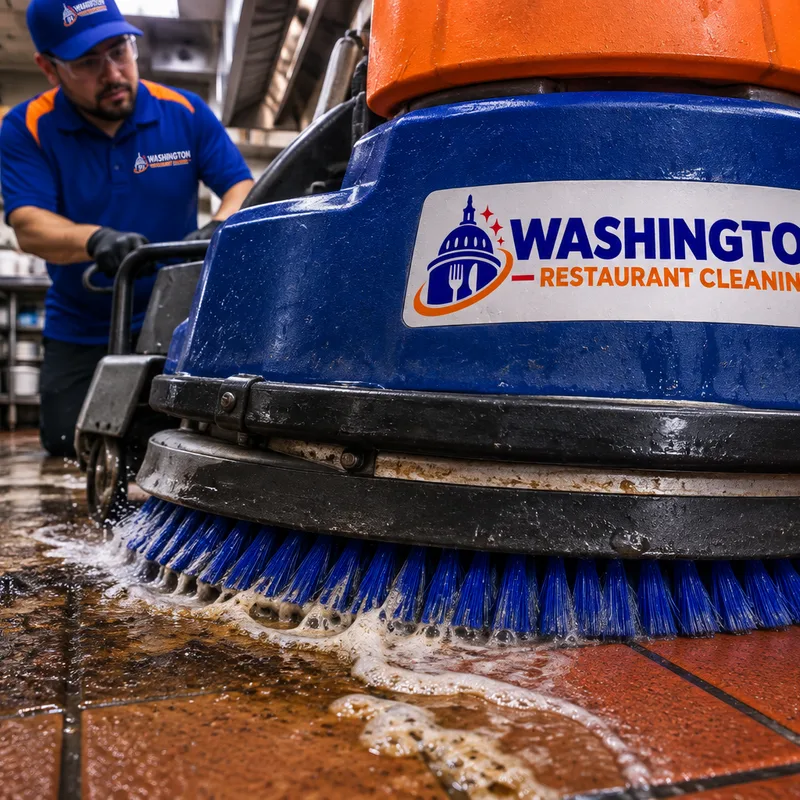
A restaurant floor can be damaged by the wrong pad, brush, chemical, or water pressure. Quarry tile commonly used in commercial kitchens can tolerate mechanical scrubbing, but grout condition, sealers, transitions, and nearby finishes still matter. Luxury vinyl tile and resilient sheet flooring need different chemistry and less aggressive abrasion. Sealed concrete requires attention to the coating, because a harsh degreaser may dull or weaken an incompatible finish.
Slip resistance also affects the plan. Texture that improves traction can trap grease and fine food particles in low points. A knowledgeable cleaner selects agitation that reaches those recesses without treating every floor as if it were bare concrete. Acidic products are not a routine answer for greasy soil, and highly alkaline degreasers require correct dilution, contact time, rinsing, and handling.
Bethesda's wet winter weather and spring rain can increase tracked moisture and grit at entrances. That abrasive material should be removed before machine cleaning so it is not ground into the finish. During humid summer periods, drying time and airflow deserve extra attention, especially in compact kitchens and interior corridors.
Budget planning
Restaurant floor cleaning in Bethesda typically costs about $0.20 to $0.60 per square foot, while minimum service charges for smaller jobs may run roughly $250 to $600. Heavy kitchen degreasing, grout detailing, overnight work, or difficult equipment access can raise the price.
Final cost depends on cleanable square footage, floor material, soil level, furniture movement, drainage, parking and loading access, and whether the work is one-time or recurring. A written scope should identify included areas and exclusions. The exact cost is confirmed after an on-site assessment or detailed consultation.
Restaurant cleaning must fit the operating schedule. Many projects are planned after the dining room closes, before food preparation begins, or during a scheduled closure. The available window needs to include setup, dwell time, scrubbing, soil recovery, detail work, and drying. A short access window may require dividing the restaurant into zones rather than rushing the process.
Before the appointment, restaurant staff should identify alarm procedures, loading instructions, restricted areas, equipment that may be moved, and surfaces that cannot get wet. Food and food-contact items should be covered or stored according to the restaurant's own procedures. If access requires coordination with a property manager, garage, or loading area, those arrangements should be settled in advance.
Washington Restaurant Cleaning operates from Washington, DC, and plans Bethesda work with travel, parking, building access, and closing times in mind. The goal is a clear handoff: both parties know which areas are included, what preparation is needed, and when the cleaned floor can return to use.
Share your floor type, approximate cleanable area, kitchen condition, and preferred service window to receive a practical scope for your Bethesda restaurant.
Scope and scheduling
The right frequency depends on customer volume, menu-related grease, floor texture, and the effectiveness of daily cleaning. A high-use cook line may need recurring deep scrubbing, while a lower-soil dining area may need periodic machine cleaning. Restaurants near busy Bethesda commercial areas may also need more entrance and traffic-lane care during wet weather.
Yes, after-hours work can be planned when access, noise limits, security procedures, and drying time are confirmed in advance. The service window must be long enough for pretreatment, scrubbing, recovery, rinsing when needed, and safe release of the area before the next Bethesda shift begins.
Equipment movement is determined during scoping, and heavy, fixed, gas-connected, or hardwired units should be handled by qualified restaurant personnel or the appropriate trade. Our team can clean accessible areas and coordinate around movable items when disconnection, weight, floor protection, and reconnection responsibilities are clearly assigned.
Secure food and food-contact items, remove loose floor mats and small movable objects, identify sensitive equipment, and provide approved access to water and suitable drainage. Staff should also communicate alarm instructions, loading arrangements, restricted areas, and the time by which the kitchen must be ready for use.
Cleaning can remove many surface soils and greasy deposits, but it cannot guarantee removal of permanent discoloration or repair cracked, eroded, or missing grout. During a Bethesda assessment, the floor's condition can be separated into cleanable buildup, staining, coating wear, and physical damage so expectations are clear.
Timing depends on square footage, soil level, floor texture, access, and the amount of detail work. A compact dining room may be completed within one service window, while a heavily soiled kitchen or multi-zone restaurant may require longer or phased work. Drying time is also affected by airflow and indoor humidity.
Yes, recurring cleaning can be based on the restaurant's traffic, menu, daily maintenance, and problem areas. The schedule can give extra attention to cook lines, warewashing routes, entrances, or server paths while assigning less frequent care to lower-soil areas.
Plan the service
Describe your Bethesda restaurant's flooring, operating hours, and problem areas. Washington Restaurant Cleaning will help define the work, preparation requirements, and a service window that fits your operation.